Surya Sarovar Yojana: Why Is the Water the Next Frontier for Solar Cells?
For more than ten years, India’s solar story has been about land. Land acquisition, resettlement issues, and agricultural rivalry have all had to be negotiated for each gigawatt of ground-mounted capacity. However, the nation’s most recent renewable energy initiative Surya Sarovar Yojana is searching for room in its reservoirs, canals, and industrial ponds.
A key component of India’s renewable energy strategy, floating solar photovoltaic panels installed on floating platforms that rest directly on water bodies, has evolved from a specialised pilot technology. Moreover, the explanations go far beyond novelty. This change also signifies a significant new demand stream for high-efficiency cell technology for producers like Celloraa Energy.
What Floating Solar Actually Solves?
Solar modules are anchored on docks or floats by floating solar photovoltaic (FSPV) systems over reservoirs, irrigation canals, hydropower dam backwaters, and industrial water bodies. There are three aspects to the standard appeal:
1. There is no land competition. To achieve India’s solar goals of hundreds of gigawatts by the early 2030’s, vast amounts of land, much of it agricultural or environmentally sensitive, would be needed. By utilizing existing water surfaces owned by industry or public utilities, floating installations completely avoid this.
2. Increased yields due to cooling water. Heat reduces photovoltaic module efficiency. Panel temperatures are kept lower than those of comparable ground-mounted arrays by being situated just over a body of water, which results in a noticeable production boost over the course of a project.
3. Lower evaporation. Water loss to evaporation can be reduced by covering even a small portion of a reservoir’s surface with panels, which is a significant co-benefit for a nation where electricity demand and water stress frequently peak in the same summer months.
Pradhan Mantri Surya Sarovar Yojana Policy Push
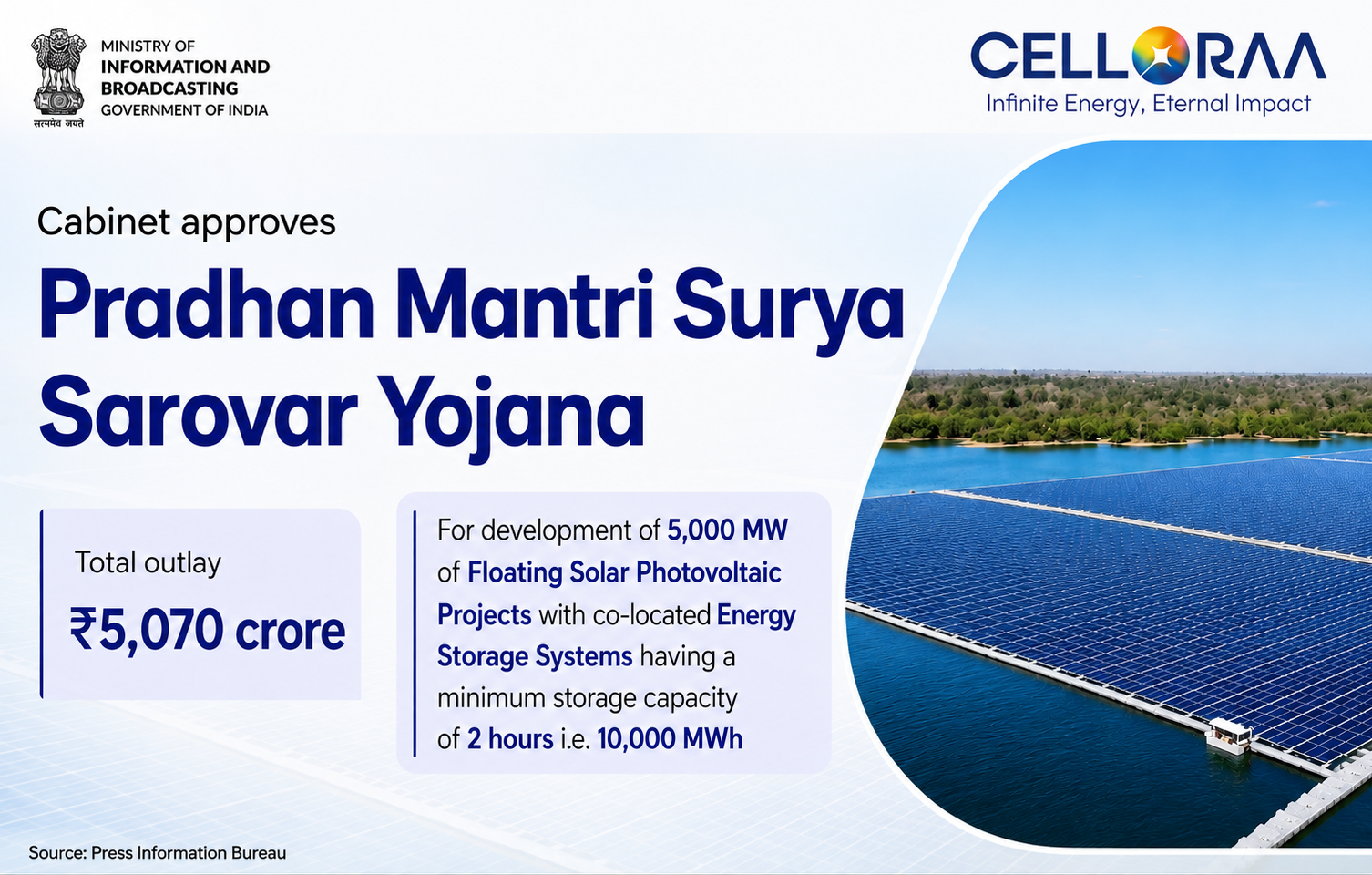
The Union Cabinet approved the Pradhan Mantri Surya Sarovar Yojana (PM-SSY), a unique plan for floating solar photovoltaic projects integrated with energy storage devices, on July 31, 2026, with a total outlay of Rs. 5,070 crore, as the clearest expression of intent.
According to the Prime Minister’s Office’s official announcement, the scheme aims to develop 5,000 MW of floating solar capacity with co-located energy storage of at least two hours’ duration (10,000 MWh in total), to be approved between FY 2026-2027 and FY 2030-2031, with financial disbursements continuing until FY 2032-2033. (PMO Press Release)
The scheme design highlights a few numbers:
- Central Financial Assistance (CFA): up to Rs. 50 lakh per project for feasibility studies that include bathymetry, hydrography, and environmental assessments, plus Rs. 1 crore per MW following successful commissioning.
- Resource potential: Compared to the existing installed floating solar base of only about 700 MW, the National Institute of Solar Energy (NISE) has calculated that India’s floating solar potential across reservoirs and other inland water bodies is approximately 102.18 GWp.
- No new land acquisition: Information and Broadcasting Minister Ashwini Vaishnaw informed the media following the Cabinet meeting that as the plan is intended to make efficient use of already-existing reservoirs, canals, and industrial ponds, no additional land acquisition is necessary.
- Employment and emissions: Throughout the project value chain, the program is expected to create 16,000 – 17,000 full-time equivalent jobs and reduce CO2 emissions by about 10 million tonnes per year.
Notably, the government has also included a clear push for domestic manufacturing; in keeping with the Aatmanirbhar Bharat vision, the scheme document expresses an intention to assist indigenous production of flotation systems as well as the entire project value chain, including PV cells, modules, and storage systems. This direction has previously been noted in earlier reports, with a push for floating solar installations worth Rs. 5,070 crores.
The rooftop-focused PM Surya Ghar Yojana, which has been promoting rooftop adoption in homes and small businesses, is complemented by PM-SSY rather than replaced. Together, the two programs show India’s efforts to harness solar energy on any surface that is accessible, including water bodies for industry and utilities and rooftops for homes.
Celloraa Energy’s Role in This Shift
In Surat, Gujarat, Celloraa Energy is constructing a 1.2 GW N-Type Celloraa TOPCon G12R solar cell manufacturing plant. This facility is designed around the large-format G12R wafer and is equipped through collaborations with prominent German technology providers. Domestically produced, high-efficiency N-type solar cells are positioned to feed directly into both segments as India scales floating solar under PM-SSY along with ongoing rooftop growth through PM Surya Ghar Yojana. Module manufacturers, EPCs, and independent power producers building out utility-scale and floating capacity will increasingly need solar cell supply that satisfies ALMM List-II compliance while matching the performance floating projects demand.
The next stage of India’s solar growth will need more than just growing capacity; it will also involve raising the necessary capacity from domestically produced solar cells in an efficient manner.