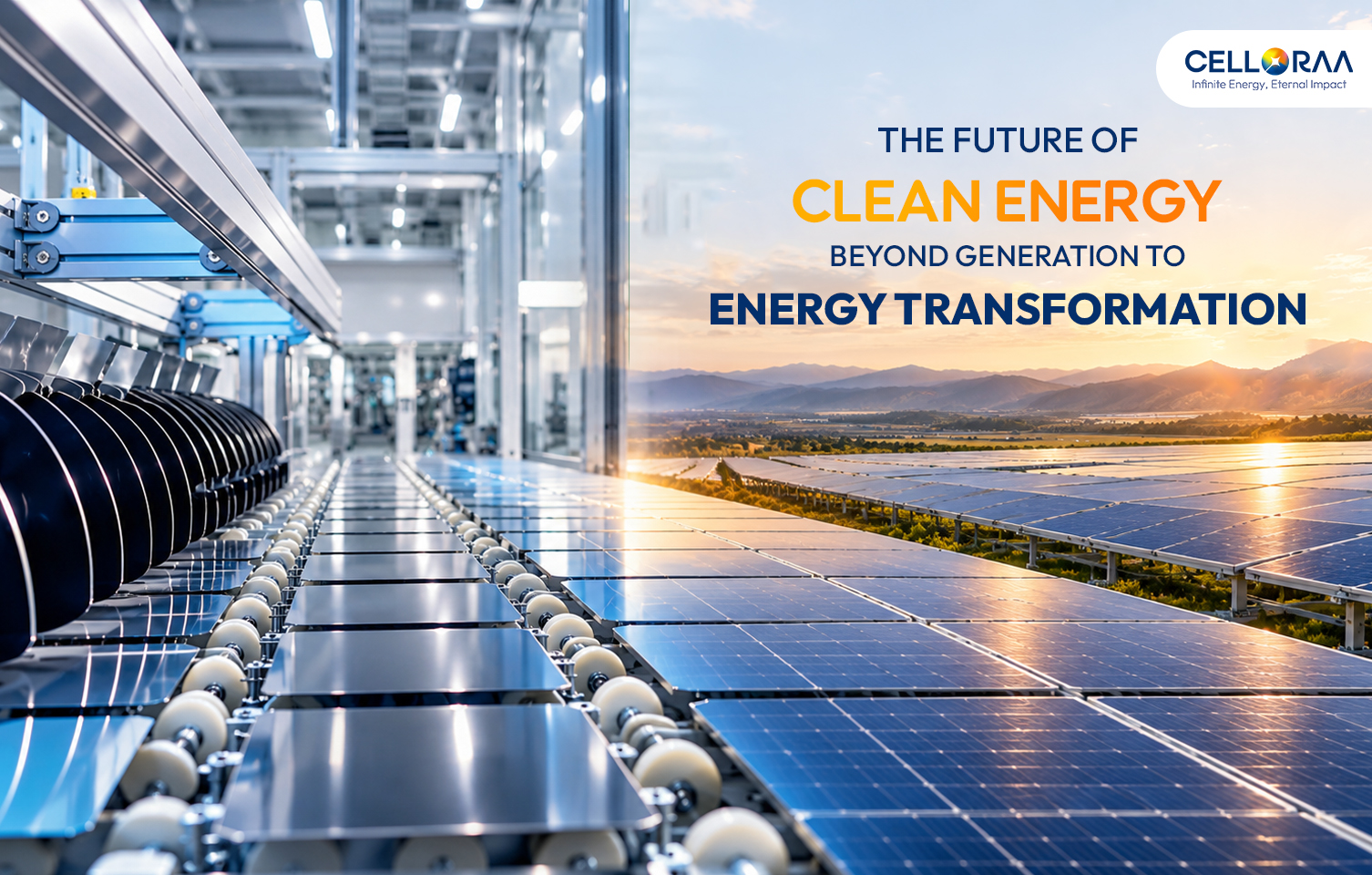
Clean Energy: Beyond Generation to Energy Transformation
Installed capacity has been at the centre of global renewable energy conversations for the last 20 years. Businesses and nations competed to lower the levelized cost of energy (LCOE), increase utility-scale farms, and add gigawatts of solar panels.
This quick scaling demonstrated that clean energy can rival fossil fuels, but it also exposed a basic fact: generation is insufficient on its own.
Adding more panels to the grid without considering technological efficiency, upstream supply chain resilience, and lifecycle sustainability does not result in a long-lasting energy system. Today, the renewable energy business is approaching a critical second phase: moving from energy generation to actual energy transformation.
Here’s what this paradigm shift implies, why the global solar business urgently requires it, and how next-generation technology is transforming vision into industrial reality.
What is Energy Transformation Beyond Generation?
Energy generation is a transactional process that involves the conversion of sunlight into kilowatt hours.
In contrast, energy transformation occurs at a systemic level. It envisions the full value chain:
From Surface-Level Assembly to Core Technology: Shifting the focus from just assembling solar panels to mastering the core semiconductor unit, the solar cell.
From Raw Volume to High Yield Efficiency: Using creative cell layouts to maximise electricity output on limited land and roof space rather than simply expanding farm footprints. From Global Supply Fragility to Domestic Sovereignty: Developing secure, locally based manufacturing capabilities to safeguard national grids against geopolitical disruptions.
From linear production to sustainable manufacturing: Ensure that the processes used to produce clean energy components are resource-efficient, low-carbon, and responsible.
In short, energy transformation involves creating a robust, high-efficiency renewable environment in which technology and manufacturing integrity are as important as the power passing through the inverter.
Why Must the Solar Industry Evolve Now?
The transition from generation to transformation is driven by three pressing structural challenges facing the global and Indian solar markets:
The “Cell Gap” in Solar Manufacturing
While countries like India have achieved remarkable strides in module assembly capacity, a critical vulnerability remains upstream: the domestic supply of high-efficiency solar cells. Assembling panels from imported cells leaves the clean energy infrastructure exposed to global supply shocks, price volatility, and trade restrictions. True self-reliance (Atmanirbhar Bharat) requires mastering cell-level semiconductor fabrication.
Policy Alignment and MNRE Directives
Government initiatives spearheaded by the Ministry of New and Renewable Energy (MNRE)-including Domestic Content Requirement (DCR) mandates and the Approved List of Models and Manufacturers (ALMM)-are actively driving this evolution. For public sector projects, government tenders, and subsidized schemes, MNRE guidelines require genuine domestic manufacturing from the cell level upward. Meeting India’s ambitious 500 GW renewable target by 2030 requires deep industrial capacity, not just surface-level assembly.
The Physical Ceilings of Legacy Tech
For years, P-type PERC technology carried the solar revolution. However, PERC has hit its practical thermodynamic efficiency barrier (around 22–23%). To power industrial decarbonization, electric mobility, and modern grid storage, the industry requires a technological leap that offers higher energy yields, lower temperature coefficients, and negligible degradation.
How We Achieve Transformation: The Celloraa Energy Blueprint
Energy transformation cannot be achieved through policy or vision statements alone; it requires advanced industrial engineering, heavy capital investment, and world-class technology partnerships.
At Celloraa Energy, we are addressing this challenge head-on by building the domestic foundation for the next era of solar energy.
Scaling Next-Generation N-Type TOPCon Technology
Transformation begins at the atomic level of the solar cell. Celloraa is establishing a state-of-the-art 1.2 GW solar cell manufacturing facility, specializing in advanced N-Type TOPCon (Tunnel Oxide Passivated Contact) G12R (210 × 182 mm) cells.
Delivering conversion efficiencies exceeding 25.2%.
Offering superior bifaciality, better low-light response, and lower degradation compared to legacy technologies.
Unlocking significantly higher lifetime power output per square meter.
Bridging the Domestic Content (DCR) Gap
By delivering 100% Made-in-India, DCR-compliant cells, Celloraa Energy supports developers and module manufacturers in meeting stringent MNRE standards. This closes India’s domestic supply deficit and strengthens the nation’s energy sovereignty from the foundation up.
German Engineering Meets Scalable Indian Manufacturing
To produce world-class Solar cell, precision is non-negotiable. Celloraa has aligned with global research and engineering pioneers:
RENA Technologies: Advanced wet-chemical processing systems for surface texture and chemical treatment.
Centrotherm: Advanced thermal processing and diffusion technology for semiconductor-grade consistency.
ISC Konstanz: Collaborative expertise with one of Europe’s foremost photovoltaic research institutes to ensure continuous technology roadmapping.
Sustainable Manufacturing Systems
A cleaner future cannot be built with dirty production practices. Celloraa embeds sustainability directly into its factory floor through water-efficient closed-loop recycling, optimized thermal energy management, and intelligent automated workflows designed to minimize the industrial carbon footprint.
The Road Ahead: The Foundation of Tomorrow’s Grid
The future of solar will not be judged merely by how many panels are deployed across open fields, but by the intelligence, efficiency, and reliability engineered into every single cell powering the grid.
As the global energy landscape shifts toward deep decarbonization, Celloraa Energy is committed to providing the solar industry with the technology foundation it need to convert raw solar potential into a long-term, sovereign energy transformation.
Explore High-Efficiency Solar Innovations:
To learn more about our N-Type TOPCon G12R cell architecture or discuss high-volume supply agreements, please visit celloraaenergy.com or contact our engineering team.
Celloraa Energy Private Limited.
Surat, Gujarat, India